From Lumberyard to Bank to Rush Plaza: The Story of 200 E. Rush
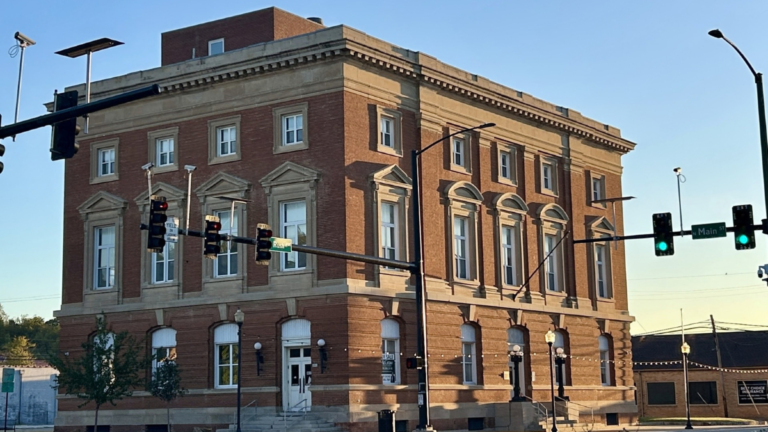
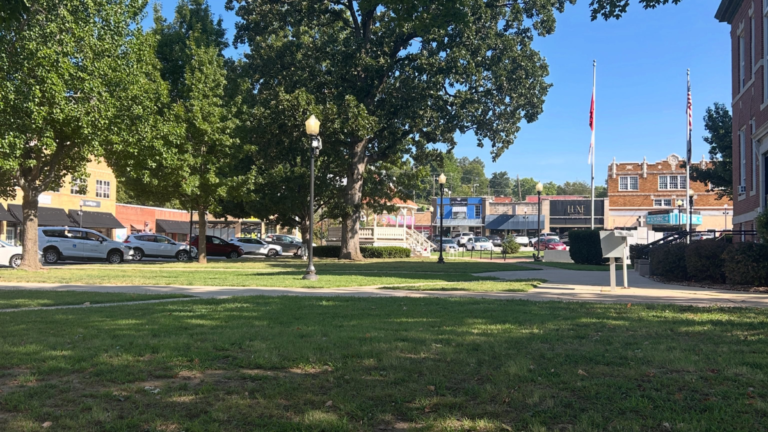
If you’ve driven past Rush Plaza at the corner of Rush Avenue and Walnut Street, you might think you know the building.
Step inside, and it’s a different story.
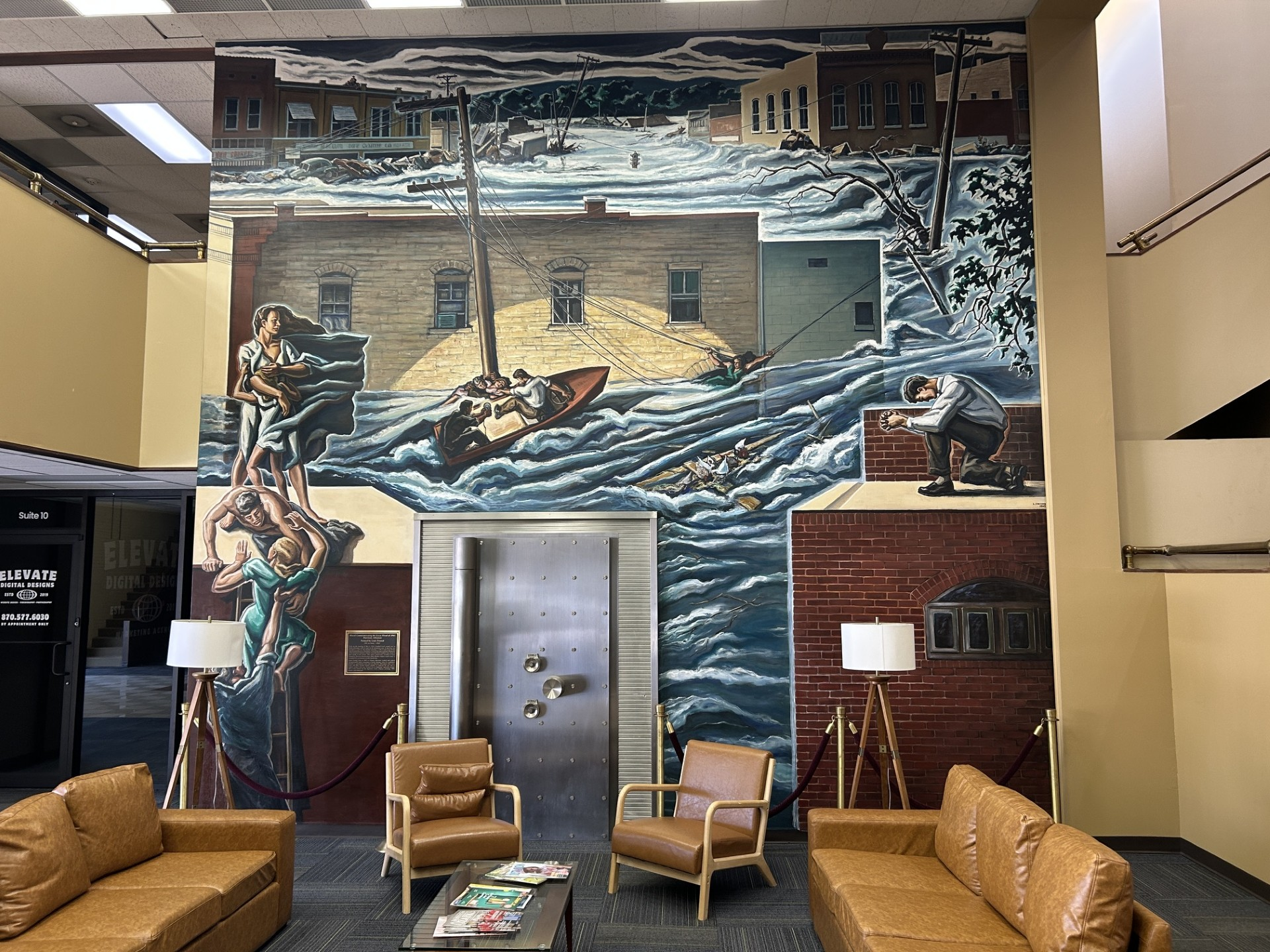
There’s the soaring two-story interior. The unmistakably mid-century ceiling. Brass railings. An enormous old bank vault. And wrapped around that vault is a mural depicting one of the most devastating days in Harrison’s history.
Today, 15 businesses call Rush Plaza home. But long before it became a multi-business center, this corner was already part of Harrison’s business story.
Before the Bank
A 1959 Harrison street directory lists Hammerschmidt Lumber Company at 200 E. Rush.
The Hammerschmidt name has deep roots in Harrison. The family lumber business was founded by John Paul Hammerschmidt’s grandfather, and Hammerschmidt later became president of the company before beginning the political career that would send him to Congress for 26 years.
Interestingly, the Hammerschmidt connection to this corner didn’t end when the lumberyard disappeared.
When First National Bank built its new building here in the 1960s, J. P. Hammerschmidt was listed among the bank’s directors on the plaque that remains on the building today.
The lumberyard was gone, but a Hammerschmidt was still connected to what came next.
A New Bank and a Remarkable Work of Art
First National Bank opened its new Harrison location in 1963. A plaque on the building records the structure as erected in 1964.
For the new bank, artist Louis Freund was commissioned to create something extraordinary.
Freund painted The Flood, a massive mural depicting the catastrophic May 1961 flood in Harrison. Rather than treating the bank vault as something to work around, Freund made it part of the composition.
He painted the mural around the vault.
More than six decades later, both are still there.
And Freund wasn’t simply a local artist hired to decorate a bank.
Born in 1905, Harry Louis Freund became a nationally recognized American artist, muralist and educator. He studied art in the United States and Paris, created public art through Depression-era federal programs, taught at several universities and, with his wife Elsie, helped establish the Art School of the Ozarks in Eureka Springs.
That makes the enormous artwork hiding in plain sight inside Rush Plaza even more remarkable.
Harrison’s Flood, Preserved on a Wall
The subject Freund chose was still a very recent memory when the bank opened.
On May 7, 1961, Crooked Creek flooded Harrison after torrential rain. Buildings were destroyed, businesses were devastated and four people lost their lives.
The historical marker at Rush Plaza describes it as the worst catastrophe in Harrison’s history. Approximately 80 percent of the buildings surrounding the square were destroyed or significantly damaged, with losses estimated at more than $5.4 million at the time.
The disaster eventually helped spur the Lake Harrison recreation project.
Freund captured that history in a mural that customers entering the new First National Bank would see every day.
It’s worth looking at closely.
From across the room, it’s impressive simply because of its size and color. Up close, it becomes a collection of individual moments from the flood, with people, buildings, rushing water and rescue scenes woven together across the wall.
And more than 60 years later, it’s remarkably vivid.
Current Rush Plaza owner Matt Fay says the mural looks as if it could have been painted yesterday.
He especially loves the colors.
Fay also loves tattoos, and he jokes that Freund’s flood scene would make a pretty great sleeve.
Once you’ve looked closely at the mural, it’s not hard to see why.
The Bank Is Still Here, Even Though It Isn’t
The building’s banking history continued through changing names and institutions over the decades, eventually including First National Bank of Berryville and First National Bank of North Arkansas, now known as Bank of 1889.
And there are reminders everywhere that this was built to be a bank.
The massive vault remains, although today its secure space is used for file storage. The brass railings remain. So does that fantastic ceiling and much of the building’s unmistakable 1960s character.
Even the bank drive-through remains in use alongside the property.
The building didn’t have to lose its past to find a new purpose.
Rush Plaza Begins Another Chapter
On September 28, 2024, the former bank building was formally introduced as Rush Plaza with a ribbon cutting.
At the ceremony, owner Matt Fay shared the story of his own journey in business and the path that eventually led to him owning the building at Rush and Walnut.
Today, instead of one institution filling the building, 15 businesses call Rush Plaza home.
That may be the best part of the building’s story.
For at least 67 years, business has been happening on this corner. A lumber company gave way to a bank. The bank building eventually became Rush Plaza. Offices now occupy spaces once designed for an entirely different kind of business.
But the history wasn’t erased along the way.
The vault is still there.
The brass railings are still there.
And Louis Freund’s Harrison flood still stretches across the wall, exactly where he painted it around a brand-new bank vault more than 60 years ago.
Sometimes preserving downtown history doesn’t mean keeping a building exactly as it was.
Sometimes it means letting it keep working.