The Lyric Theater: A Harrison Landmark Saved for Its Second Act
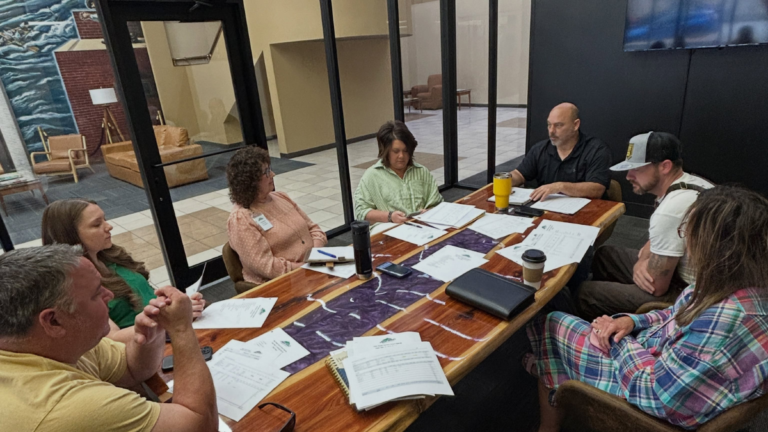
The Lyric Theater recently received its Main Street Harrison mini-grant check, continuing a long tradition of people investing in one of downtown Harrison’s most important landmarks.
For nearly a century, the Lyric has adapted to changing times while giving Harrison a place to gather. It began as a theater built for an exciting new kind of motion picture, narrowly escaped demolition decades later, and was eventually transformed into the working performing arts venue it is today.
Its story is not simply about saving an old building.
It is about the extraordinary amount of work required to make that building useful again.
Built for the Talkies
The original Lyric Theater was located on the west side of the Harrison square and operated as a silent movie theater.
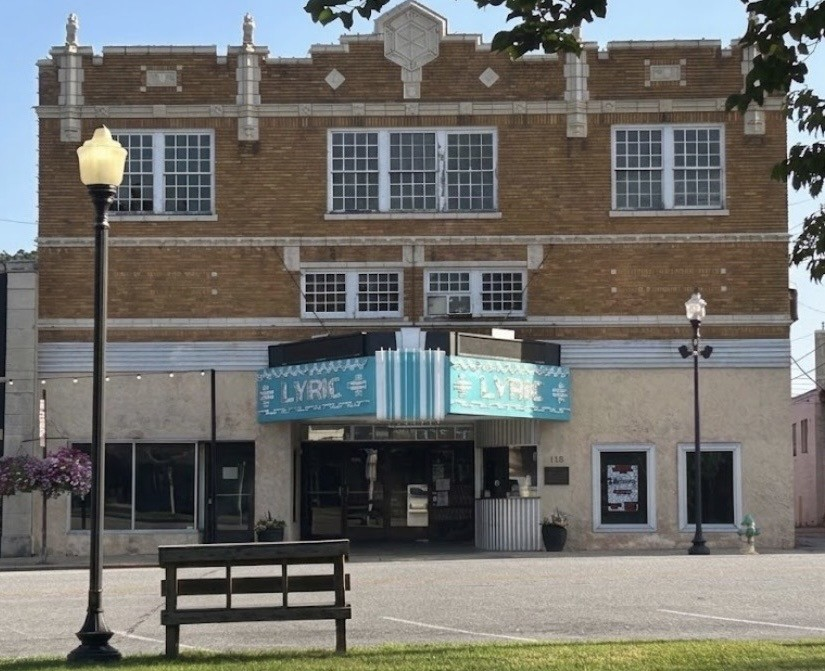
As motion pictures with synchronized sound became more common, the original theater could not accommodate the new technology. Builder J.W. Bass constructed the Lyric Theater that stands today as a state-of-the-art theater designed for “talkies.”
On November 7, 1929, Universal Pictures’ Broadway became the first talking picture shown in Harrison.
The new theater included a projection room, concession stand, balcony, and other features associated with the movie houses of the period. The original projection room and concession stand remain in the building today, and a full pull-down movie screen allows the Lyric to continue showing films.
Another historic feature is the theater’s crying room. Crying rooms allowed parents to take a restless or crying child out of the auditorium without leaving the theater completely. They could continue watching the movie through a glass window without disturbing the rest of the audience.
Although the Lyric’s crying room and original projection room are now used for storage, both have been retained as part of the building’s history.
The Murals of the Lyric
Six large murals decorate the walls inside the theater.
For many years, local tradition held that they had been painted by an unknown hobo artist who worked in exchange for food and shelter.
Research eventually uncovered a different story.
The murals were painted by J.W. Zelm, a known and sought-after muralist who had been commissioned to decorate the theater. Zelm traveled throughout the South for his work, and although his name was eventually lost from local memory, he was not simply a passing artist who happened upon Harrison. The Lyric is believed to be the only place in Arkansas where his work is regularly accessible to the public.
At some point, the murals were covered with burlap wall coverings and largely forgotten. When the coverings were later removed, the artwork was rediscovered.
Years of water damage, fading, and holes had taken a toll. Local artists patched the damaged areas and restored the murals, preserving one of the theater’s most distinctive historic features.
From Movie House to an Uncertain Future
The Lyric continued showing movies until 1977, when it closed after a modern theater opened at the Ozark Mall.
The downtown theater then remained largely unused for approximately a decade. The Harrison Daily Times, located next door, eventually considered purchasing the building, demolishing it, and using the property for additional parking.
Glenna Ragan stepped in and purchased the Lyric, saving it from destruction.
She used the theater for occasional events and later leased it to Homer Sewell, who presented a one-man performance portraying President Abraham Lincoln. Although the Lincoln show was performed regularly, it was not enough to cover the considerable cost of operating and maintaining the aging theater.
The building continued to deteriorate.
The Lyric had escaped the wrecking ball, but saving a building from demolition and restoring it to useful life are two very different things.
A Home for the Arts
In 1996, Ozark Arts Council president Jim Gresham began exploring how the Lyric could become a permanent home for the performing arts in Harrison.
Following an extensive fundraising effort, the Ozark Arts Council purchased the theater on April 9, 1999, for $150,000.
What the organization acquired was historically significant, but it was nowhere close to being ready to function as a modern performance venue.
The roof leaked. The building had no air conditioning. Heat came from its original 1929 steam boiler. The electrical wiring was inadequate, holes marked the walls, and the stage was too small for many live productions.
The theater also lacked basic backstage necessities.
There were no proper dressing rooms, backstage bathrooms, or adequate wing space beside the stage. During the earliest productions, performers changed costumes in stairwells and whatever corners they could find.
When they needed a bathroom, they ran out the back door, crossed the alley, and used one inside the Harrison Daily Times building next door.
A camouflage parachute purchased from a military surplus store served as a makeshift stage curtain. Temporary lighting and sound equipment had to be used for performances.
Those conditions make the scale of the Lyric’s transformation even more remarkable.
Rebuilding a Working Theater
Restoration required much more than a fresh coat of paint and a new curtain.
Four large heating and cooling units were installed on the roof. The entire building was rewired. A new stage, dressing rooms, bathrooms, and a sound and lighting booth were built.
The dressing rooms were created in the basement, along with backstage access to both sides of the stage. The stage itself was enlarged to better accommodate live productions.
The balcony had been condemned and had to be renovated before audiences could once again be seated upstairs. Light towers and grids were built, and a new sound system was installed.
The original steam boiler also had to be dismantled. Removing it required hauling approximately 16 tons of metal out of the building.
That detail alone helps illustrate the physical scale of the work. Restoring the Lyric was not one dramatic rescue followed by a tidy ribbon cutting. It was years of people confronting one enormous problem after another and asking, “What does the building need next?”
The restoration preserved original elements wherever possible while making the theater functional for modern performances.
The result was not a museum or an empty historic shell.
It was once again a working theater.
Making Room Behind the Stage
Even after the initial restoration, the Lyric’s original backstage area remained extremely limited.
In January 2006, an addition known as the annex was constructed behind the theater. It provided room to build and store sets, a hospitality area or green room for visiting performers, and mezzanine storage for props and costumes.
The stage was expanded again in December 2007, when a new sound system and sound booth were also installed. The theater’s seats were later removed and restored, and repairs were made to the auditorium floor before the refurbished seats were reinstalled in 2009.
The annex may not be visible to an audience seated inside the auditorium, but it is essential to the work taking place onstage.
Sets must be designed and constructed. Props and costumes must be stored. Visiting performers need somewhere to prepare. Every production requires tools, materials, equipment, and enough room for people to work.
The addition helped transform the Lyric from a historic building capable of hosting occasional events into a fully functioning performing arts venue.
A Main Street Story
Harrison was one of Arkansas’s early Main Street communities, first joining the program in 1985. The city has participated in the Main Street program during more than one period, and downtown preservation and revitalization efforts have continued through local organizations, businesses, volunteers, and residents.
The Lyric’s connection to Main Street runs through that history.
In 2001, the Ozark Arts Council received a Main Street Harrison award for Community Commitment. The following year, the Lyric received the statewide Main Street Arkansas award for Best Building Rehabilitation Over $500,000.
In August 2025, Harrison once again received official Main Street Arkansas designation. More than two decades after those earlier awards, the Lyric’s Main Street Harrison mini grant continues a long tradition of investing in this historic downtown building.
More Than a Building Saved
The story of the Lyric is not simply that an old theater escaped demolition.
It is the story of everything that happened after it was saved.
One person prevented the building from becoming a parking lot. An arts organization then accepted the much larger challenge of purchasing, repairing, improving, and operating it.
Businesses, donors, artists, volunteers, and community members contributed money, materials, expertise, and labor. Each improvement made it possible for the Lyric to serve another audience, host another performer, and welcome another generation through its doors.
The story of the Lyric also lives in the people who grew up there, performed there, worked there, and later helped preserve it for the next generation.
Today, the building constructed for Harrison’s first talking pictures hosts plays, concerts, films, educational programs, and other community activities.
Its balcony welcomes theatergoers again. Performers have dressing rooms and backstage bathrooms. Sets are built in the annex instead of being squeezed into an impossibly small backstage area.
And children can stand on its expanded stage to learn, rehearse, and sing.
The Lyric was not preserved simply because it was built in 1929.
It was preserved because historic buildings can continue serving their communities when people are willing to see their possibilities, invest in them, and do the difficult work required to keep them useful.
The Lyric’s greatest preservation success is not that it still stands.
It is that, nearly a century later, it is still doing its job.
Historical information for this article was drawn from the Lyric Theater’s official history and restoration records, City of Harrison records concerning Harrison’s Main Street designation, and details shared during a recent tour of the theater.