When Harrison Had a “Dead Man’s Corner”
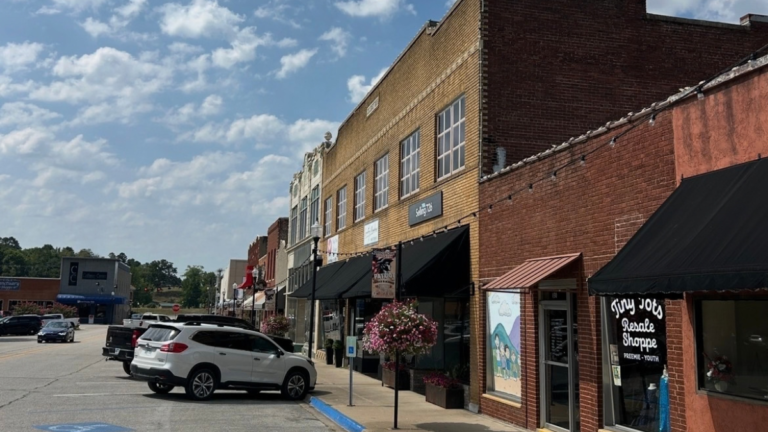
Historic downtown is more than its buildings. Its streets and corners also hold stories, including one that earned the southeast corner of the Harrison square a rather unsettling nickname.
In his 1955 book, Boone County and Its People, Ralph R. Rea described Harrison during the 1880s and 1890s as a rougher place than the downtown we know today. The streets were dirt, wooden buildings with false fronts surrounded the square, and hitching racks stood where horses waited while their owners conducted business.
There were two saloons on the south side of the square and another on the east side. Saturday night brawls and gunplay were reportedly common. According to Rea, more than twenty gun battles occurred at the southeast corner of the square, causing it to become known as “Dead Man’s Corner.”
The Aderholt-Pace Shooting
Rea chose to recount one shooting in particular because it involved several prominent local men.
Monroe L. Aderholt had arrived in Boone County from the western frontier in 1867. He accumulated extensive real estate holdings, including a 300-acre farm southwest of Harrison, and operated one of Boone County’s bonded distilleries. Rea wrote that Aderholt was generally respected, but was also considered a dangerous man to cross.
During a domestic dispute, Aderholt’s wife retained Captain Henry Pace as her attorney. Aderholt attempted to intimidate Pace into withdrawing from the case and eventually shot him, causing a minor wound. Afterward, Pace and his three sons, Frank, Henry, and Troy, armed themselves.
A few days later, Aderholt and members of the Pace family encountered one another near the southeast corner of the square.
Henry Pace was standing near a small restaurant on the corner. Frank was nearby, and Troy was across the street on the south side of the square. Rea wrote that no one living at the time his book was published knew who drew first. Gunfire erupted between Henry Pace and Aderholt.
Aderholt was wounded and fell in the street. From the ground, he fired at Frank Pace, with three shots reportedly missing Frank and splintering the cornice boards of the restaurant. Troy Pace also fired a shot. Aderholt lost consciousness and died from his wounds.
The Case Against the Pace Brothers
A Boone County grand jury indicted Henry, Frank, and Troy Pace for second-degree murder.
Circuit Judge E. G. Mitchell disqualified himself so that he could testify for the defense, and Sheriff Ceaf Parker did the same. A special judge and special sheriff were appointed for the proceedings.
Frank Pace was tried first and found not guilty. The cases against Henry and Troy were continued until the following term of court, when both were dismissed by the state.
Rea did not attempt to document every reported gun battle associated with Dead Man’s Corner. He included this account because of the prominence of the people involved and the community’s reaction to the shooting.
The Corner Today
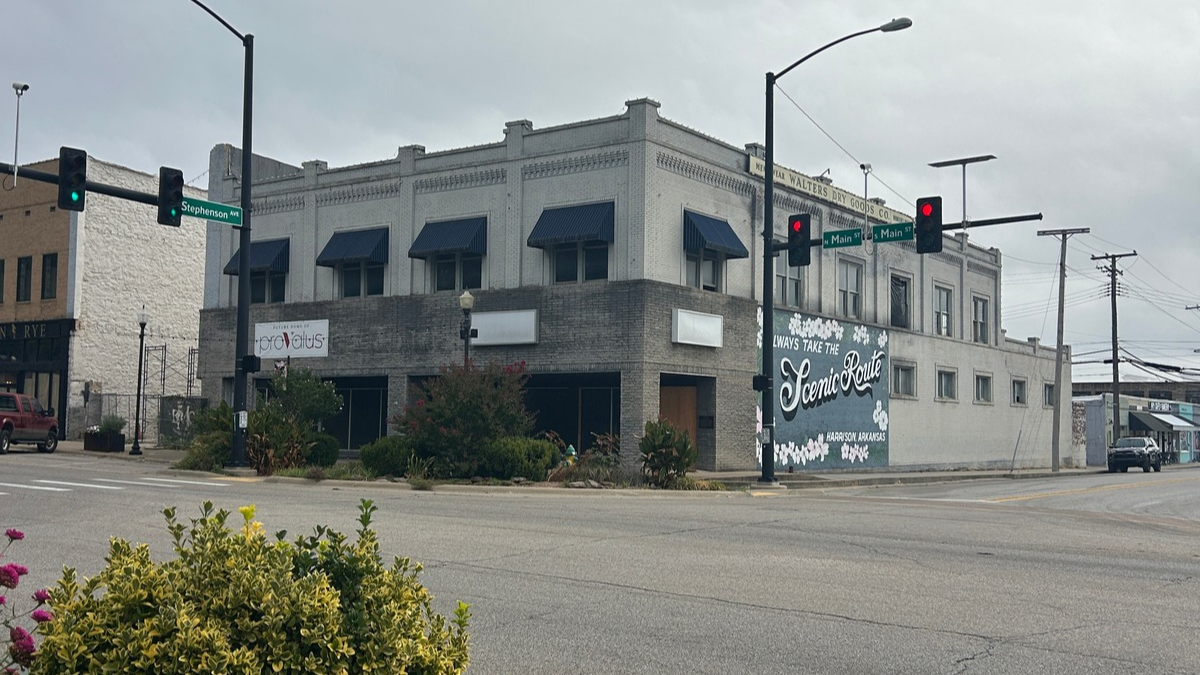
Today, the corner of Main Street and Stephenson Avenue bears little resemblance to the place Rea described. The dirt streets, hitching racks, wooden restaurant, and saloons are gone. Drivers stop beneath traffic lights, and most people passing through the intersection would have no reason to suspect its former nickname.
Buildings are only part of downtown’s history. The streets, sidewalks, and familiar corners also carry stories of the people and events that shaped Harrison. Preserving those stories helps us see an ordinary downtown corner in an entirely different way.
Source: Ralph R. Rea, Boone County and Its People, Press-Argus, Van Buren, Arkansas, 1955, pp. 120–132.